Poor Folk by Fyodor Dostoevsky [PDF]
by InfoBooks
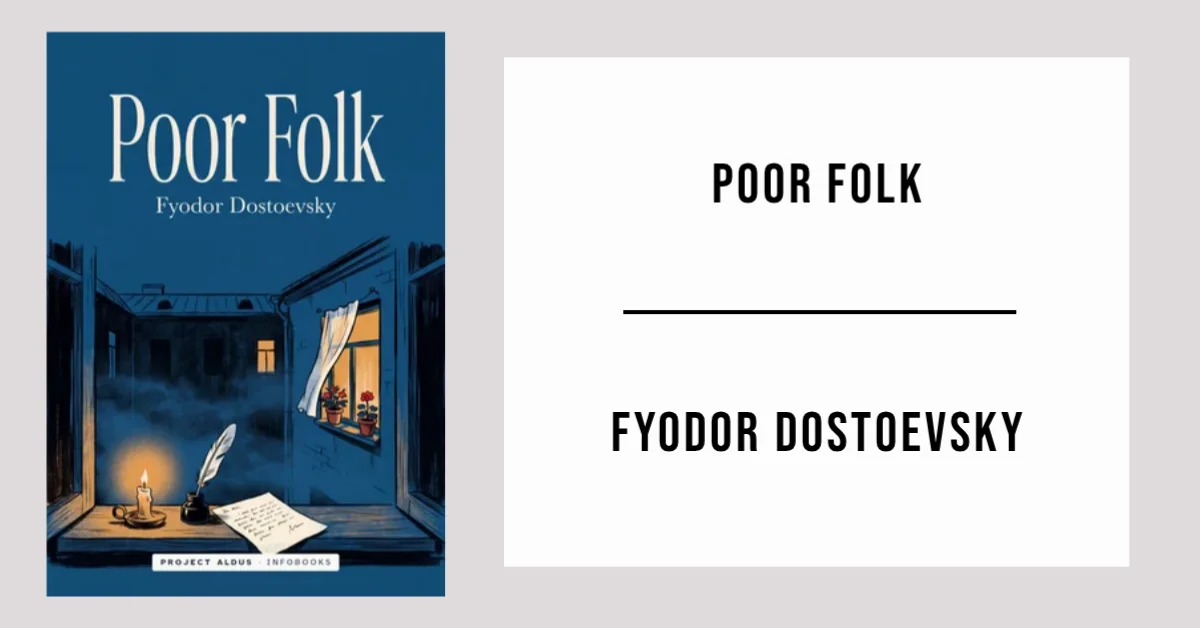
Makar Dievushkin swears he rented a corner of a kitchen for comfort's sake alone. In the same letter he lets slip that his window is just opposite Barbara's, across a narrow courtyard, and that is how Poor Folk, Dostoevsky's first novel, gets its start.
This version of Poor Folk in PDF is our own edition from Project Aldus: the complete novel, set so you can read the letters one after another without tiring.
The download is free and needs no sign-up. One click and you have the whole correspondence, from April to September, ready on your screen.
Poor Folk by Fyodor Dostoevsky
*Please wait a few seconds for the document to load, the time may vary depending on your internet connection. If you prefer, you can download the file by clicking the link below.
Loading PDF...
Information: Poor Folk
- Author: Fyodor Dostoevsky.
- Publication Date: 1846.
- Main Characters:
- Makar Dievushkin: An ageing copying clerk who lives in a corner of a kitchen and writes to Barbara almost every day.
- Barbara Dobroselova: A young orphan who lives across the courtyard from Makar and tells him the story of her childhood in a notebook.
- Thedora: The devoted woman who lives with Barbara and looks after her.
- Pokrovski: A poor student who lodged in Anna Thedorovna's house when Barbara lived there, and whom she remembers in her notebook.
- Gorshkov: A dismissed clerk who lives with his family in Makar's lodgings, in great poverty.
- Mr. Bwikov: A wealthy landowner from Barbara's past who returns to Petersburg with an offer of marriage.
- Brief Summary: "Poor Folk" is a novel in letters by Fyodor Dostoevsky. Makar Dievushkin, an ageing copying clerk in Petersburg, writes almost every day to Barbara Dobroselova, a young orphan who lives across the courtyard from him. He spends what little he earns on presents for her and hides how poor he is becoming, while she worries about him and tells him the story of her childhood. Their lives grow harder with debts, illness and gossip, until Mr. Bwikov, a rich man from Barbara's past, returns to Petersburg and asks for her hand
- Thematic Analysis: "Poor Folk" explores poverty and the dignity of those who live in it. Through the letters of Makar and Barbara, the novel shows how money, shame and the opinion of others shape their affection for each other, and it gives a voice to the humble clerks and lodgers of Petersburg who rarely had one in literature.
- Historical Context: "Poor Folk" was published in 1846 in the Petersburg Miscellany, an anthology edited by Nikolai Nekrasov, in the Russian Empire of Nicholas I. It was Fyodor Dostoevsky's first novel, and the critic Vissarion Belinsky greeted it with enthusiasm. The novel belongs to the Russian literature of the 1840s that turned its attention to the poor of the capital. The English translation is by C. J. Hogarth, first published in 1915.
Collection
Books by Fyodor Dostoevsky
Here is our complete collection of free books by Fyodor Dostoevsky