Furniture design books teach you why one chair invites you to sit and why another leaves your back aching. Our collection covers chairs, tables, cabinets and storage, from the first sketch to the finished piece.
The selection goes well beyond design theory. You will find the anthropometrics behind a comfortable seat, the measured drawings a workshop can build from, the materials and craftsmanship that hold a cabinet together, and the history of the styles every designer borrows from.
Furniture making and cabinet making share a border with other trades, so you can also browse our carpentry books, upholstery books and interior decorating books. Every title here downloads for free, with no registration and no limits.
📚
Download every Furniture Design book on this page
All the books on this page in one ZIP file, instead of downloading them one by one.
We will redirect you to accounts.google.com to complete sign-in.
Email and name only · We never send spam
Access unlocked
Download every Furniture Design book on this page
All the books on this page in one ZIP file, instead of downloading them one by one.
Direct download · One ZIP file
Download started. Check your downloads folder for the ZIP.
Essentials
Furniture Design Books
Start here if furniture design is new to you. These books cover proportion, joinery and the decisions that come before any drawing.
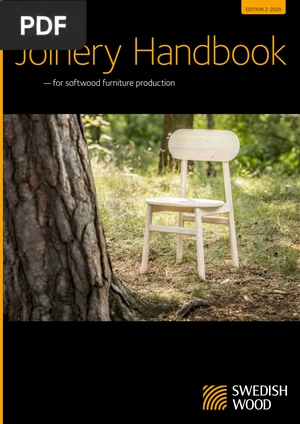
Covers how solid softwood becomes furniture, from designing and drawing through machining, joints, gluing and surface treatment. Written with production in mind, with a full chapter on designing for disassembly and repair.
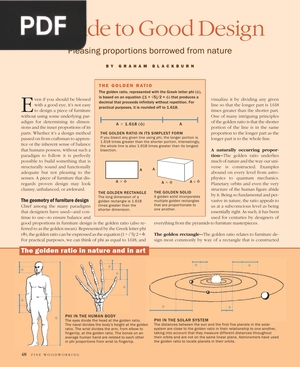
A short lesson on the golden ratio and how proportion decides whether a piece of furniture looks balanced or clumsy. Practical geometry you can apply to your next design in an afternoon.
A classic handbook on building cabinet furniture, covering tools, joints, veneering and setting out work, plus a survey of how furniture design developed. Detailed enough to work from at the bench.
Combines essays on furniture history, taste in design, color and materials with hundreds of shop recipes for staining, varnishing, polishing and gilding. Illustrated with more than 200 drawings.
Every style you recognize today was somebody's radical idea once. These books trace furniture from period craftsmanship to modern design, with plates and measured examples throughout.
Course notes that trace furniture from ancient Egypt through the great European periods to modern design. Heavily illustrated, with each style set against the culture that produced it.
A survey of furniture from the earliest known pieces to the late nineteenth century, organized by period and style. Hundreds of illustrations make the stylistic shifts easy to follow.
A guide to recognizing old furniture, from Jacobean oak and Queen Anne walnut through mahogany and painted pieces, with over a hundred illustrations. Useful for anyone dating or restoring antiques.
The pattern book that defined an entire style of furniture, with designs for chairs, sofas, tables, beds, sideboards and cabinets. A primary source that designers still borrow from today.
Walks through the period styles in interior decoration and how furniture, textiles and color work together in a room. Practical guidance on furnishing coherently instead of collecting pieces at random.
A reference on anthropometrics, posture and workplace measurement, with percentile data and the reasoning behind seating and workstation dimensions. One of the clearest ergonomics primers available for furniture designers.
Sets out dimensional standards for office furniture, workstation layouts and space allocation, with criteria covering durability, flexibility and ergonomics. A concrete example of how furniture gets specified at scale.
Reviews how biomechanics informs the design of chairs, desks, beds and other furniture, covering pressure distribution, posture and comfort evaluation methods. A current overview of the research behind ergonomic decisions.
A design nobody can build is just a picture. These manuals teach how to draw furniture with scale, dimensions and construction details a workshop can follow.
Notes on the elementary forms, construction methods and standard dimensions of common furniture, written for design students. Teaches how to draft a piece so that a workshop can actually build it.
An account of the theory and practice of cabinet work and furniture production, illustrated with over a thousand workshop drawings, photographs and original designs. The most complete technical reference in this collection.
Scale drawings of historic furniture held at the Victoria and Albert Museum, with dimensions and construction details recorded piece by piece. Ideal for studying proportion or reproducing a period design.
The four part treatise that taught cabinet makers geometry, perspective and drawing before presenting its famous designs. Both a drafting course and a catalogue of neoclassical furniture.
A large collection of household furniture designs in the Gothic, Chinese and modern taste, with mouldings shown at full size and dimensions given for each design. Includes an explanation of the five orders of architecture and the rules of perspective.
The reference on how wood behaves as a material, covering species properties, moisture movement, machining, gluing, fastenings and finishing. Everything you need to know before choosing a wood for a piece of furniture.
A reference and formula manual on stains, fillers, shellacs, varnishes and waxes for furniture finishers and woodworkers. Hundreds of tested formulas with the reasoning behind each finish.
Covers finishing, decorating, repairing and patching furniture, from surface preparation through color matching and damage repair. Comprehensive enough to work as a shop manual.
Small rooms and limited materials push furniture design forward. These works cover multifunctional pieces, zero waste cutting and furniture that changes with the space.
A design project developing a multifunctional bed and cabinet for small apartments following inclusive design principles. Shows the full process from user research and ergonomics study through to a finished concept.
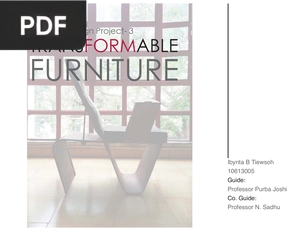
A design study on multifunctional furniture that transforms to get more out of a small room, built on focus groups and user research. Documents the process from problem framing to final concept.
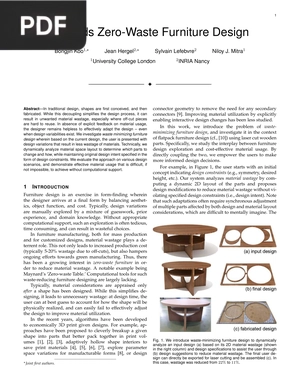
Presents a computational method that suggests design variations to cut offcut waste while preserving the designer intent. A look at how software can make material efficiency part of the design process.