Data analysis turns raw numbers into decisions, and these books show you how. Here you will find free data analysis books in PDF, from the statistical foundations of data science to hands-on work with Python and R.
Our selection gathers university textbooks, research handbooks, and practical manuals released under open licenses. They cover descriptive statistics, exploratory data analysis, data wrangling, data visualization, and qualitative research methods, the ground a working data analyst covers every day.
Every title is free to read online or download, with no registration and no limits. Pick the book that matches your level and start reading right now.
📚
Download every Data Analysis book on this page
All the books on this page in one ZIP file, instead of downloading them one by one.
We will redirect you to accounts.google.com to complete sign-in.
Email and name only · We never send spam
Access unlocked
Download every Data Analysis book on this page
All the books on this page in one ZIP file, instead of downloading them one by one.
Direct download · One ZIP file
Download started. Check your downloads folder for the ZIP.
Fundamentals
Data Analysis Books
General handbooks that cover the whole analysis process, from framing the question to reporting the result. Start here if you want the method before the tooling.
A step by step handbook that walks through the full data analysis cycle, from planning what to collect to interpreting and reporting results. Written for program staff with no statistics background, it uses plain language and worksheets at every stage.
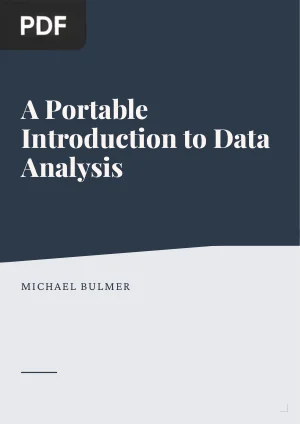
A university course book that builds data analysis from the ground up, structured in three acts: exploring data, modelling it, and drawing conclusions. Covers variability, study design, distributions, hypothesis testing, and regression with worked examples throughout.
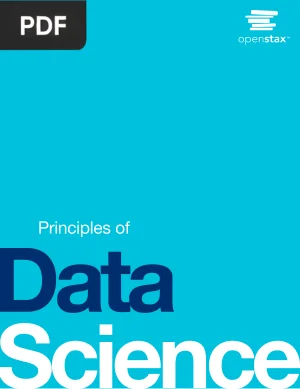
A complete introductory textbook covering the data science workflow end to end: collecting and cleaning data, descriptive and inferential statistics, visualization, regression, and an introduction to machine learning. Includes exercises and examples in both Python and R.
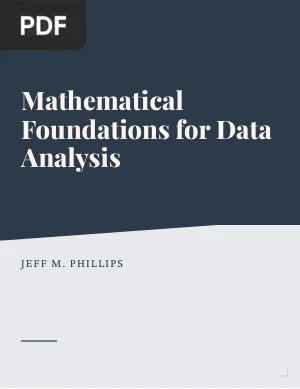
The mathematical toolkit behind modern data analysis, covering probability, linear algebra, distances, clustering, regression, and dimensionality reduction. Built from two university courses designed to prepare students for rigorous machine learning work.
An advanced treatment of topological data analysis, covering persistent homology, Reeb graphs, and discrete Morse theory, with algorithms for applying them to real datasets. Aimed at readers who already have a solid mathematical background.
Python is the most widely used language for data analysis and AI today, and pandas, NumPy, and matplotlib carry most of the work. These books teach the full workflow with real datasets.
A compact course book that teaches data science with Python from the first line of code, covering NumPy arrays, pandas DataFrames, data cleaning, and plotting. Short enough to work through in a single term.
The most widely used free Python book for people who want to work with data rather than build software. Teaches the language through practical tasks: reading files, scraping web data, calling APIs, and storing results in databases.
Exploratory data analysis taught as a working process: import and clean the data, explore one variable, then pairs, then build models. Every technique is shown as Python code applied to a real national survey dataset.
A complete tutorial on the scientific Python stack, written by the core developers of the libraries themselves. Covers NumPy, matplotlib, SciPy, pandas, scikit-learn, and image processing, moving from first steps to advanced numerical work.
Gael Varoquaux, Emmanuelle Gouillart, Olav Vahtras, Pierre de Buyl
R was built for statistics, and it remains the reference environment for exploratory data analysis and reproducible reports. These books cover the tidyverse, ggplot2, and the classic EDA workflow.
A hands-on R course built around public health and epidemiology datasets. Starts with installing RStudio and moves through data wrangling with dplyr, summary tables, and plotting with ggplot2, with practice questions and solutions in every chapter.
A short and direct first contact with R, covering the data structures, how to read and write files, and how to produce graphics and run basic statistical models. Ideal if you want the essentials without a 400 page commitment.
The official R manual, kept current with every release of the language. Covers the data types, reading datasets, writing your own functions, statistical models, and the graphics system, straight from the team that builds R.
A workbook that teaches R for social research through the tidyverse, from descriptive statistics and bivariate analysis to multiple regression and categorical predictors. Every chapter pairs the code with the reasoning behind the choice of method.
A chart is where analysis becomes an argument. These books cover chart selection, visual design, and how to communicate results to people who did not run the numbers.
A practical guide to building charts, maps, and tables that tell a clear story, using free tools you can start with today. Covers chart selection, spreadsheet and Tableau workflows, interactive maps, and how to spot a misleading graphic.
A course book on turning analysis into a message an audience will act on. Covers choosing the right chart for the question, dashboard design, storytelling with data, and the visual choices that mislead readers without anyone noticing.
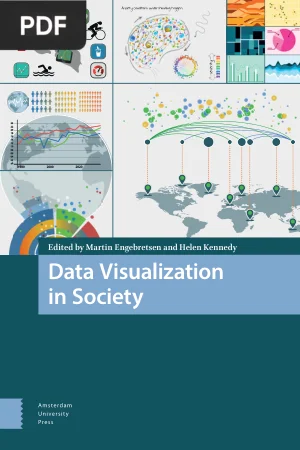
An edited collection on what data visualizations actually do once they reach the public: how people read them, how newsrooms build them, and what gets lost in the translation from dataset to picture. Strong on the ethics and politics of visual data.
Descriptive statistics, hypothesis testing, and regression are the backbone of quantitative analysis. These titles apply the math to real research data instead of teaching theory on its own.
A short, self-testing guide to the statistics a research student actually needs, from descriptive measures and distributions through t tests, ANOVA, correlation, and regression. Worked examples use the free jamovi software.
Erich C. Fein, John Gilmour, Tanya Machin and Liam Hendry
A full university statistics course written around the idea that the point of the method is the meaning you extract from the data. Covers sampling, estimation, hypothesis testing, and regression with real datasets at every step.
A rigorous treatment of the statistical methods used to analyze experimental measurements, covering error propagation, parameter estimation, likelihood, hypothesis tests, and deconvolution. Written for readers working with real experimental data.
A very extensive treatment of modern statistical data analysis, covering regression, smoothing, causal inference, time series, and simulation, all worked through in R. Nearly 900 pages built from a Carnegie Mellon course.
A clear guide to collecting and analyzing qualitative data, covering interviews, focus groups, ethnography, and archival work, with dedicated chapters on coding, memoing, and building themes from transcripts.
A textbook that treats qualitative and quantitative analysis as two halves of the same craft, covering coding and content analysis alongside descriptive statistics and significance testing. Uses real social science datasets throughout.
A thorough research methods textbook with extensive coverage of qualitative design and analysis, including sampling, interviewing, coding transcripts, and reporting findings. Also covers quantitative measurement and survey design for mixed methods work.
A practical companion for analyzing psychology research data, moving from describing distributions to running and interpreting t tests, ANOVA, and correlations. Each unit pairs the concept with the steps to carry it out in R.
These books take you from your first dataset to clear charts and reproducible reports. If you want the languages themselves rather than the analysis, start with our programming books.
SQL and stored data are the other half of the job, covered in our database books. For spreadsheet analysis see our Excel books, and for the theory behind the methods our statistics books.