Discover our collection of free combinatorics books in PDF, ready to download with no cost and no registration. Combinatorics is the branch of discrete mathematics devoted to counting, arrangement, and the enumeration of possibilities.
Inside you will find titles on permutations and combinations, generating functions, and graph theory. From beginner introductions to advanced texts on enumerative, analytic, and algebraic combinatorics, there is a book for every level.
Start reading today and practice with problem sets from math olympiads and university courses. Pick a title, download the PDF, and explore the world of counting and combinations.
📚
Download every Combinatorics book on this page
All the books on this page in one ZIP file, instead of downloading them one by one.
We will redirect you to accounts.google.com to complete sign-in.
Email and name only · We never send spam
Access unlocked
Download every Combinatorics book on this page
All the books on this page in one ZIP file, instead of downloading them one by one.
Direct download · One ZIP file
Download started. Check your downloads folder for the ZIP.
Introductory
Books on Combinatorics (Introductory & General)
Start here if you are new to counting, permutations, and combinations. These introductory books and lecture notes build a solid base in combinatorics.
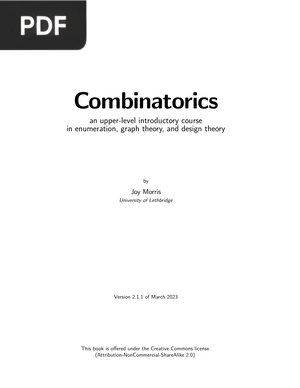
An upper-level introduction that moves from enumeration into graph theory and design theory. Its clear structure and worked examples make it a strong single reference for a full combinatorics course.
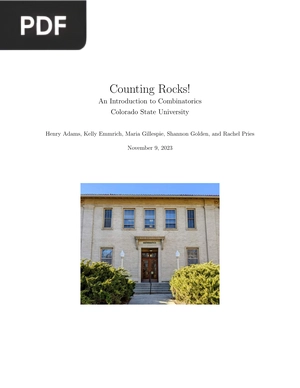
A modern undergraduate introduction that pairs each chapter with linked videos and guided investigations. It covers counting problems, proof techniques, recurrences, generating functions, and graph theory.
Henry Adams, Kelly Emmrich, Maria Gillespie, Shannon Golden, Rachel Pries
A compact first course covering permutations, binomial coefficients, inclusion and exclusion, generating functions, and an entry into graph theory. A good pick for readers who want the essentials without extra length.
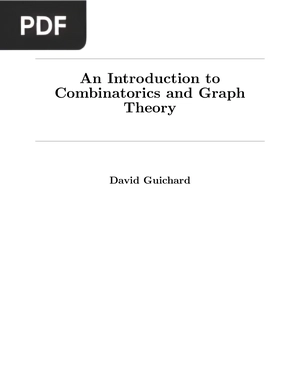
A comprehensive applied text spanning binomial coefficients, graph theory, partially ordered sets, generating functions, probability, and network flows. Its breadth makes it useful well beyond a first course.
University lecture notes built around basic counting principles, the twelvefold way, and multinomial coefficients. Clear and example driven for a first pass through the subject.
An accessible text that starts from the Fibonacci numbers and builds toward generating functions, distributions, and the pigeonhole principle. Well suited to readers who want intuition alongside the formulas.
Concise lecture notes on elementary enumeration, binomial identities, inclusion and exclusion, recursions, and generating functions, with practice problems closing each section.
A problem based text that leads readers to discover combinatorial ideas through carefully sequenced questions rather than lectures. Ideal for active, hands on learning.
Course notes from a leading combinatorialist, opening with familiar puzzles like sudoku before developing counting, arrangements, and the core techniques of the subject.
Go deeper into enumeration, generating functions, and the symbolic method. These texts cover enumerative and analytic combinatorics for advanced readers.
The definitive graduate reference on enumeration, covering sieve methods, partially ordered sets, and rational generating functions in depth. A demanding but rewarding text for serious students of counting.
The definitive treatment of analytic combinatorics, combining the symbolic method with complex analysis to derive precise asymptotics for large combinatorial structures. A cornerstone reference on generating functions.
A classic and highly readable introduction to generating functions and their uses across discrete mathematics. It shows how these tools bridge counting problems and continuous analysis.
An elegant introduction to algebraic combinatorics through walks in graphs, the Sperner property, Young diagrams, q-binomial coefficients, and the Matrix Tree Theorem. Each chapter is a self contained gem.
A rigorous graduate introduction that starts from formal power series and builds through integer partitions, permutations, and symmetric polynomials to the Littlewood Richardson rule. Includes over 200 exercises.
Lecture notes organized around problem solving, covering the pigeonhole principle, Ramsey theory, and the principle of extremals with many solved and practice problems. A concise bridge toward competition style combinatorics.