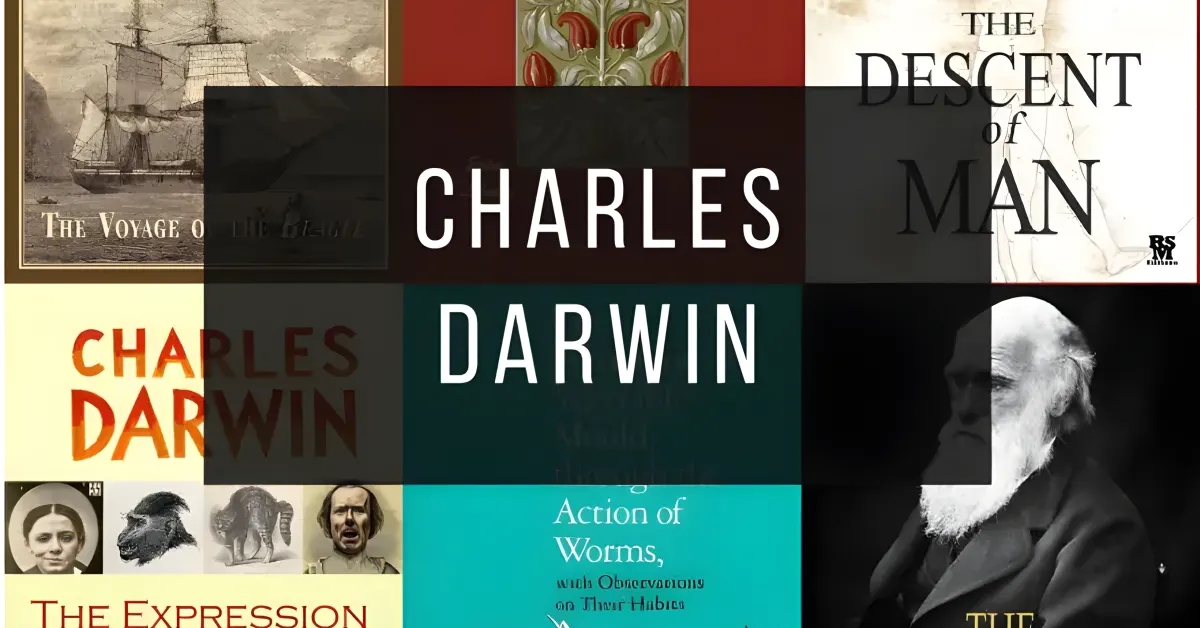
Charles Darwin was the English naturalist whose theory of natural selection changed how we understand life on Earth. He was born in Shrewsbury in 1809 and spent five years aboard HMS Beagle before publishing the book that reshaped modern biology.
This page brings together 17 free Charles Darwin books in PDF format. You will find his major works on evolution next to the botany, geology, and autobiographical writing that filled the rest of his Victorian career.
Every title here is a primary source, written by Darwin himself. Pick any book below and start reading, with no registration and no limits.
📚
Download every book on this page in one click
Sign in with Google and grab them all without going one by one.
We will redirect you to accounts.google.com to complete sign-in.
Email and name only · We never send spam
Access unlocked
Download every book on this page in one click
Get them all together, without going one by one.
Direct download · One ZIP file
Download started. Check your downloads folder for the ZIP.
Evolution
Charles Darwin Evolution Books
These are the books that built the theory of evolution by natural selection. Start with On the Origin of Species if you are reading Darwin for the first time.
Darwin's central work, where he sets out evolution by natural selection and the evidence behind it. This edition opens with his historical sketch of earlier thinking on the question.
Darwin applies evolution to our own species and develops his theory of sexual selection. A long, closely argued book that traces human origins through comparative anatomy and animal behavior.
A study of how emotions show in the face and body, and why the same expressions turn up across species. Darwin treats blushing, weeping and fear as biological questions.
Darwin gathers the evidence for variation and heredity from domesticated animals and cultivated plants. Volume one covers dogs, horses, pigeons and the crops he studied most closely.
The second volume turns to inheritance, crossing and the causes of variability. It contains Darwin's hypothesis of pangenesis, his attempt to explain how traits pass between generations.
The two early essays, written in 1842 and 1844, in which Darwin first set out natural selection in full. Useful for seeing how the argument of the Origin took shape years before publication.
Darwin spent decades studying plants in his own garden and greenhouse. These books show how closely he watched the smallest details of the living world.
Darwin's experiments on sundews, Venus flytraps and bladderworts, and how these plants capture and digest prey. A patient record of tests carried out over many years in his own greenhouse.
A detailed study of how plants move, bend and respond to light, gravity and touch. Written with his son Francis, it opened the path that later led to the discovery of plant hormones.
How twining stems, tendrils and hooks let plants climb, described through close observation of dozens of species. A short, focused book on one of Darwin's favorite botanical puzzles.
Darwin examines why some species produce two or three distinct flower forms, and how that arrangement promotes cross-fertilization. His work on primroses runs through the whole volume.
Darwin's last book, on how earthworms build and turn over the soil beneath us. Forty years of observation on a subject nobody had taken seriously as geology.
The five-year voyage of HMS Beagle gave Darwin the evidence for everything that followed. These books cover the journey itself and the geology he worked out along the way.
Darwin's account of the five-year survey voyage that took him to South America, the Galapagos and the Pacific. Part travel narrative, part field notebook, and the source of much that followed.
Darwin's explanation of how atolls and barrier reefs form as islands slowly subside. The theory he proposed here held up long after the voyage that inspired it.
Geological observations from the volcanic islands the Beagle visited, from the Cape Verdes to Ascension and Mauritius. Written for readers who want Darwin the field geologist.
Darwin's own short account of his life, his education, his working habits and his changing religious views. Written for his family rather than for publication.
The first volume of Darwin's life and correspondence, edited by his son Francis. It opens with the autobiographical chapter and follows Darwin from childhood through the Beagle years.
The second volume covers the publication of the Origin of Species and the debate that followed. Darwin's letters show the theory being defended and refined year by year.
Darwin wrote for readers who wanted the evidence laid out in full, so these books reward patience. If you are opening one today, On the Origin of Species is the place to start.